A lab's turnaround quote is only useful if it measures the same thing as the quote next to it. Two labs can both promise a crown "in seven days" and mean different things by it. One counts from the day the case arrives; the other counts from the day the practice ships it.
This article sets out how practices can compare labs on one clock, where crown days actually go, and how a US lab and an offshore lab differ once transit is counted. It also covers what to ask for in writing and how to test a lab with a single case.
How Dental Lab Turnaround Time Is Defined
Turnaround is one clock. It starts the day the case leaves the practice and stops the day the finished restoration arrives back. Everything in between belongs on that clock: transit to the lab, production, and transit home.
Labs do not always quote it that way. A quoted figure often starts only when the lab receives the case, which leaves outbound transit outside the number. Some quotes also stop when the restoration ships, which leaves out the return trip. Neither is dishonest, but neither is the number a practice schedules a patient around.
The practical fix is to ask each lab where its count begins and ends, then rebuild the figure on the practice's own clock. A practice that does this for every lab it considers can put quotes side by side without guessing.
A quoted turnaround is also a typical-case figure. It does not guarantee a date for a complicated case, and it says nothing about what happens if the restoration needs adjustment.
Crown Turnaround Time: Where the Days Go
Crown turnaround time is the sum of several production stages plus the two shipping legs. Most delays come from one of those stages or from a repeat of them, so the stages are worth knowing before any lab is compared.
Production Stages That Set a Standard Crown's Pace
A standard crown moves through the same broad sequence at most labs:
- Design. The technician designs the crown from the scan or impression, the prep margins and the opposing bite.
- Milling or layering. A zirconia crown is typically milled and then sintered. A layered porcelain crown is built up by hand in stages and fired between them.
- Glazing and finishing. The surface is glazed, stained as needed and polished.
- Fit check. The technician checks margins, contacts and occlusion on the model before the case is cleared to leave.
- Return shipping. The finished crown travels back to the practice.
Zirconia and layered porcelain follow different production paths, so they do not take the same number of days. Sintering and firing cycles are fixed by the material, and a lab cannot shorten them without risking the result. A lab's quoted time for one material says little about the other. Practices that place a lot of zirconia work can read what to look for in a zirconia crown lab before comparing quotes.
The stage that tends to surprise practices is the one nobody sees. A case that waits for a missing detail, such as a shade, a margin question or an unclear bite record, stops moving until someone answers. Complete submissions shorten turnaround more reliably than any rush option does.
How Remakes Restart the Clock
A remake does not pick up where the first crown stopped. It repeats production and the return trip, and it often adds a second outbound trip if the practice has to send the crown or a new impression back.
Take a typical case. Lab A quotes a shorter first pass than Lab B, but its crown fails fit and goes back. The second pass repeats design, fabrication, finishing and shipping. Lab B's slower first pass, delivered correctly, finishes before Lab A's second attempt arrives. One remake can cost more time than a faster quote saved.
This is why accuracy belongs in any turnaround comparison. A lab with a fast first pass and a high remake rate is slower in practice than its quote suggests.
Comparing Dental Lab Turnaround Time: US and Offshore Labs
For a US practice, the comparison between a domestic and an offshore lab comes down to two separate legs: production and transit. Mixing them is how offshore labs get judged unfairly in both directions.
No verified industry-wide figures are used here, because lab practices vary widely. The comparison below is qualitative, and practices should fill in each lab's own numbers.
| US lab | Offshore lab | |
|---|---|---|
| Production | Set by the lab's workload and material | Set by the lab's workload and material; not automatically slower |
| Transit out | Short domestic leg | Longer international leg |
| Transit back | Short domestic leg | Longer international leg, plus possible customs time |
| Remake exposure | Remake adds a short return trip | Remake adds a full international round trip |
Production Time at a US Lab
A US lab's main advantage is a short, predictable shipping leg in both directions. Its production time still depends on its own queue, its staffing and the material ordered. A domestic lab with a backlog can deliver later than a well-run lab farther away.
Practices that want a local reference point can look at crown lab services for US practices and note how each lab states its production time.
Production Plus Transit at an Offshore Lab
An offshore lab adds transit days in each direction and possible customs time that a US lab avoids. Those days are real, and they belong on the practice's clock.
Production is a separate question. An offshore lab's production time should be judged on its own days. It may be the same as a domestic lab's, or shorter, if its production line runs steadily. Assuming it is slower repeats a habit that skews the comparison.
The limit is plain: an offshore lab cannot beat a US lab on transit, and no production speed removes the extra shipping legs. It suits planned cases with a comfortable seat date better than same-week emergencies.
Addressing the Shipping-Time Objection Before Switching
The common objection to an offshore or remote lab is shipping time. The objection is fair, and it can be answered with arithmetic rather than reassurance: count every leg, then schedule backward.
Dental Lab Shipping Time in Both Directions
Dental lab shipping time has three parts that a quoted production figure leaves out:
- Transit out, from the practice to the lab.
- Transit back, from the lab to the practice.
- Any customs time on either leg.
Practices control the first leg more than they realize. How a case is packed, when it is picked up and which service level is chosen all set the outbound days. The shipping instructions for practices explain how a case is packed and sent.
The return leg is the lab's to confirm. Practices should ask for the carrier, the service level and the typical transit window, rather than assume them.
Checking Monde's Delivery Windows Against the Seat Date
Monde's site runs the workflow end to end: practices register an account, check pricing online, submit cases, and ship them to the lab, so the practice controls the steps that start its side of the clock. Practices that want to ship a case to the lab can find the delivery windows on that page, or confirm them directly with the lab. Those confirmed windows are the figures to schedule with, not estimates from elsewhere.
With the windows in hand, the schedule runs backward from the seat date:
- Start with the date the patient is booked to receive the restoration.
- Subtract a buffer for one remake.
- Subtract transit back, including any customs time.
- Subtract production.
- Subtract transit out. The result is the latest date the case can leave the practice.
For an offshore crown tied to a fixed seat date, the case has to leave early enough to cover production, transit out and back, and some buffer for customs or a remake. If that date has already passed, the case is better handled another way, or the seat date moves.
This method does not promise same-week delivery, and it does not make a long transit shorter. It shows whether the numbers fit before the patient is booked.
Fast Dental Lab Turnaround Claims to Verify
Practices weighing urgent cases often search for fast dental lab turnaround or a quick turnaround dental lab. Those phrases appear on many lab sites, and they mean little until the terms behind them are clear.
A claim of speed is a claim about one leg of the clock. It may describe production only, for one material, on a case with no complications. Practices should treat it as a starting question rather than an answer.
Three points decide whether a fast claim holds up:
- Whether the quoted time includes transit. A figure that stops at the lab's door leaves out days the practice still waits.
- The remake policy. A fast quote with unclear remake terms can end up slower than a steady one.
- How delays get reported. A lab that tells the practice about a hold early lets the practice move the appointment. A lab that stays silent lets the date pass.
What a Lab Should Put in Writing
Anything the practice relies on should be in writing, not left to a phone call. A lab that is confident in its process will normally state these points on its pricing or policy pages or in a written reply:
- The start and end points of its quoted turnaround.
- Production time by material, such as zirconia versus layered porcelain.
- The carrier and transit window for each direction, and who handles customs.
- Whether and how it remakes a restoration that fails fit, and who pays the return shipping.
- How it notifies a practice when a case is delayed.
A lab that cannot answer these in writing has not given the practice enough to schedule against.
Pricing Transparency When Comparing Lab Quotes
Turnaround and price are linked, so quotes need one common basis. Comparing a headline crown price from one lab with an all-in figure from another produces the wrong winner.
A fair comparison lines up four items for each lab:
- Price per crown, by material.
- Shipping charges, in both directions.
- Any rush surcharge.
- Remake terms, including who pays for the second pass and its shipping.
Rush work commonly carries a surcharge, so a faster quote should be compared with the standard price and with the number of days it actually saves. A rush option is worth paying for only when those days fit the seat date. If the standard schedule already meets the date with a buffer, the surcharge buys nothing.
Monde lets practices check pricing online. A practice can register a lab account first and then read the prices against the other quotes on the same four items. Pricing seen on the site still has to be matched with the delivery windows from the lab, because price alone says nothing about days.
Running a Test Case Before Moving Volume
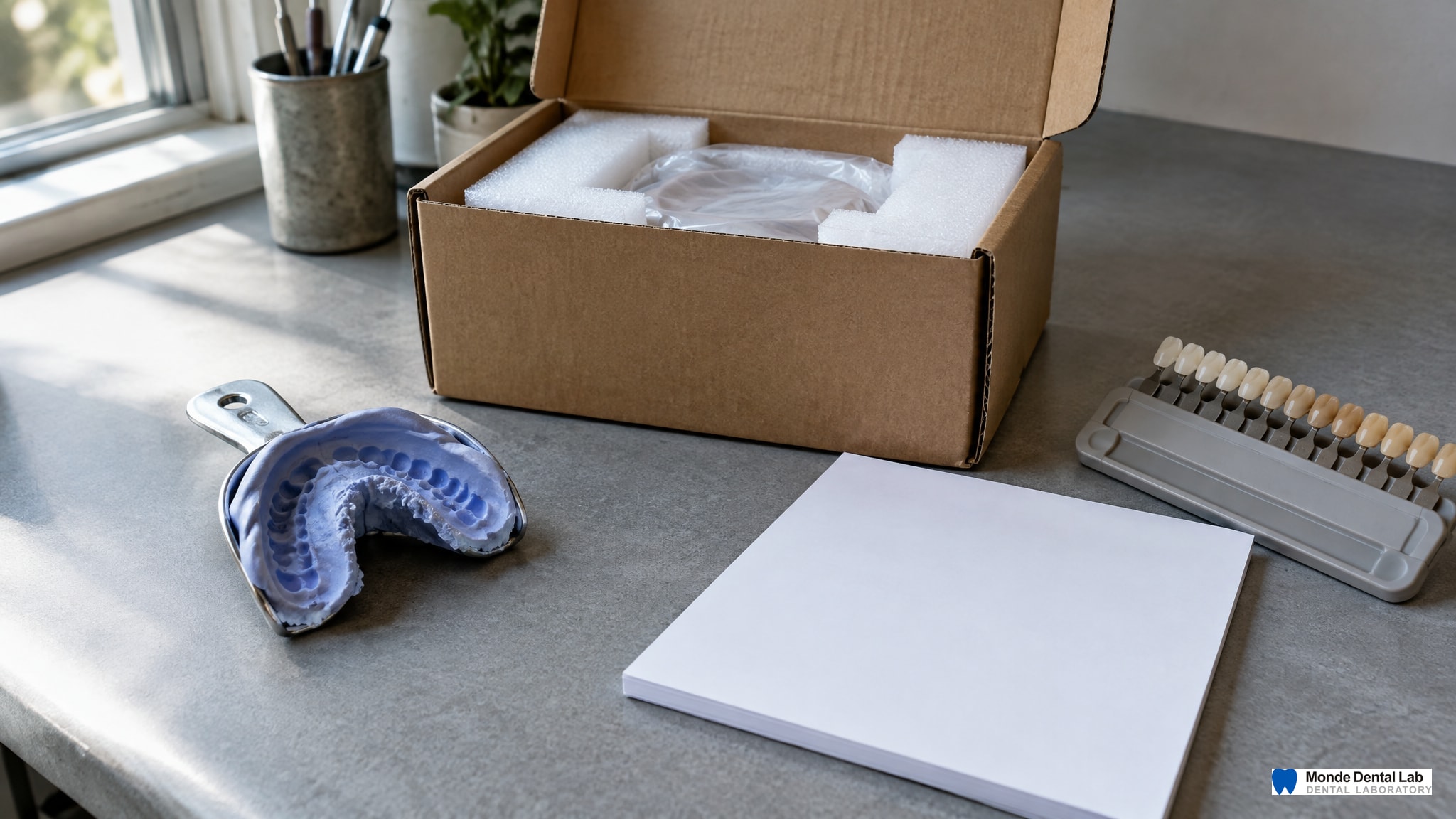
A quote shows what a lab says it does. A single routine case shows what it does for that practice, on that practice's shipping route and with its own staff handling the steps.
The test runs in four steps:
- Register an account.
- Submit one routine case online, following the step-by-step case submission process.
- Ship the case.
- Track it to delivery and record the dates.
Choose a case with a flexible seat date. A test is not the place for an urgent patient, and one case does not prove a lab's remake rate. It shows the practice its real turnaround, and it shows how easy the submission and shipping steps are for the staff who do them daily.
Dates to Log From a Test Case
Practices that send a test case should write down the dates at each stage:
- The submission date, when the case was entered online.
- The ship-out date, when the carrier collected it.
- The delivery date, when the finished restoration arrived at the practice.
- Any adjustment needed at the seat appointment, and the extra days it added.
Then set those dates against the turnaround the lab quoted. The gap between the quoted figure and the logged days, counted from ship-out to delivery, is the practice's real turnaround. That is the number to schedule with before any volume moves.
Frequently asked questions
Is an offshore dental lab always slower than a US lab?
No. An offshore lab adds transit days in each direction and possible customs time, so the shipping legs are longer. Its production time can match or beat a domestic lab's, so practices should measure production and shipping separately before judging either one.
Where can practices find Monde's delivery windows?
They are on the Ship A Case page, and the lab can confirm them directly. Practices should schedule with those confirmed windows rather than estimates, and add a buffer for a remake.
Is a rush crown worth the surcharge?
Only when the days it saves fit the seat date. Compare the rush price with the standard price and with the number of days actually saved. If the standard schedule already meets the date with a buffer, the surcharge adds cost without benefit.
What should a practice do when a lab's quote starts at receipt of the case?
Add the outbound transit days and the return transit days to the quoted figure to build one clock from the day the case leaves the practice to the day the restoration returns. Ask the lab for its carrier and transit windows in writing to make that sum accurate.
How many cases should a practice send before moving volume?
One routine case is enough to show the submission steps, the shipping legs and the real turnaround against the quote. It does not show a lab's remake rate, so practices can send further cases with flexible seat dates before committing more work.