
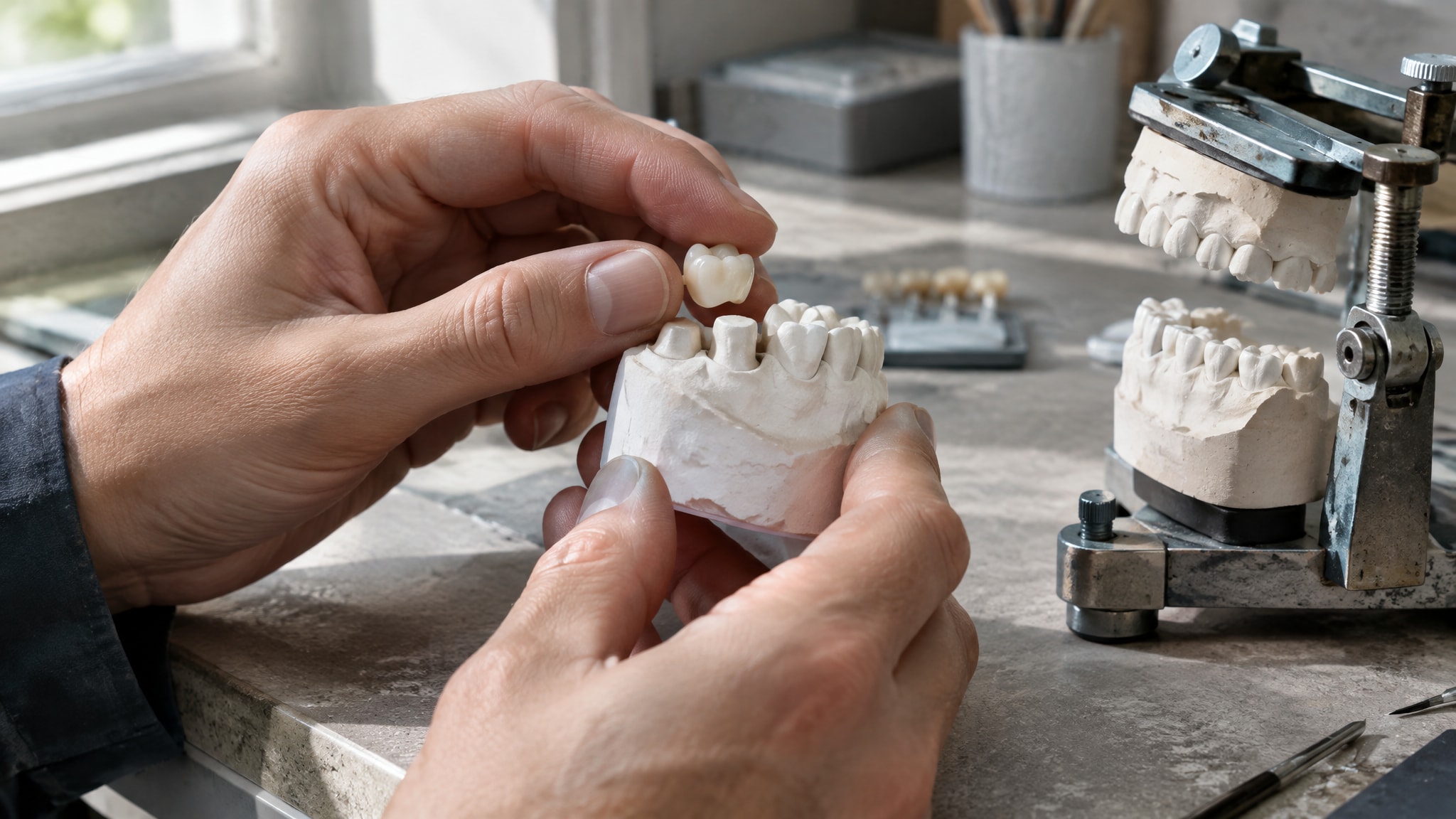
Choosing the best dental lab for zirconia crowns is easier when a practice tests labs against the same short list of criteria. Zirconia is unforgiving once it reaches the chair, so the criteria that matter most are the ones that can be checked before the first case ships.
This guide ranks those criteria, explains how to verify each one, and uses Monde Dental Lab's documented workflow as a benchmark for comparison.
How to rank a dental lab for zirconia crowns
Fit accuracy comes first, shade matching second and turnaround third. The order follows the cost of getting each one wrong.
| Rank | Criterion | Why it sits here | When it moves |
|---|---|---|---|
| 1 | Fit accuracy | Zirconia is hard to adjust once seated, so a poor fit usually means a remake | Stays first for every case |
| 2 | Shade matching | A visible mismatch is a remake even when the fit is perfect | Moves up for anterior and other visible teeth |
| 3 | Turnaround | A fast crown that does not seat is slower than a crown that arrives later and fits | Rises when a patient deadline is fixed |
Turnaround ranks last because speed only counts for crowns that seat. A lab that ships quickly but sends back a remake has added days, not saved them.
A ranking is not a verdict on any one lab. It tells a practice which evidence to ask for first, and a lab that cannot produce evidence on fit should not advance to the shade conversation.
Fit accuracy: the first test for any zirconia crown lab
Fit is the one criterion a practice cannot repair on its own. Shade can sometimes be corrected with stain, and a late crown can be bridged with a temporary, but a crown that does not seat has to be made again.
How a lab verifies marginal fit before shipping
A zirconia crown lab should check three things on the model or digital scan before a crown leaves the building:
- Marginal adaptation: the crown margin meets the prepared margin without gaps or overhangs.
- Proximal contacts: the contacts with neighbouring teeth are present and not so tight that the crown will not seat.
- Seating: the crown sits fully on the die or model without rocking.
The practice should ask which of these checks the lab records for each case, and ask to see an example of that record. A lab that describes its checks in general terms but cannot show a documented one has given an assurance, not evidence.
The lab's checks are also only as good as the impression or scan it receives. A practice that sends a clear margin and a clean scan gives any lab a fair chance of passing these checks.
Why zirconia fit must be right at delivery
Zirconia is very hard, so chairside adjustment is slow and leaves a surface that needs polishing. A fit problem caught on the model costs the lab a few minutes; the same problem found at seating costs the practice chair time, a rescheduled patient and a second shipment in each direction.
That cost is the reason fit ranks above everything else. A practice should also ask how the lab handles a seating issue: who the practice contacts, whether the crown is returned for adjustment or remade, and whether that process is written down. The answer should be a defined procedure, not "we'll sort it out."
Shade matching and translucency for monolithic zirconia
A monolithic zirconia dental lab has to get translucency right as well as colour. Higher-translucency zirconia looks more natural in visible teeth but gives up some strength, so the lab and the practice need to agree on the grade before milling starts.
Monolithic zirconia is strength-led: one material, milled and sintered, then stained and glazed. It is usually the choice for posterior crowns, where bite forces matter more than a perfect optical match. Layered or veneered zirconia puts porcelain over a zirconia core. It offers more shade control, but it adds steps and another place for the result to vary.
Choosing translucency by tooth position
Tooth position should guide the material before the shade is chosen. Anterior zirconia crowns often call for higher-translucency monolithic or veneered zirconia, while posterior crowns usually prioritize strength.
A practice comparing labs should check that each one offers the translucency grades and both material types the cases require. Premolars sit in between, so the decision there depends on how much of the tooth shows when the patient smiles.
What to send with a shade request
A shade request that includes a photo, a shade-guide reading and a note on the stump shade gives the technician far more to work from than a shade name alone. The full set of inputs is:
- the shade-guide reading, taken under consistent lighting;
- photos of the shade tab beside the tooth;
- the stump shade, since a dark preparation affects the final colour;
- characterization notes, such as mamelons, white spots or stain at the neck.
The lab should confirm the shade back to the practice before fabrication begins. That confirmation is the earliest point at which a shade misunderstanding can be caught, and a lab that skips it is relying on the first crown to be right.
Turnaround for zirconia crown fabrication: where the time goes
Dental lab zirconia turnaround is the sum of several steps: design, milling, sintering, staining and glazing, and shipping in both directions. A turnaround quote means little until those steps are named and transit time is counted both ways.
Sintering cannot be rushed without consequences, so a lab that quotes a very short turnaround should be asked which steps it has shortened. A practice should also ask which steps the lab runs in-house. Each outsourced step adds a handoff, and each handoff adds waiting time and another place for a case to stall.
Turnaround does not tell a practice anything about quality. A short quote and a poor fit can coexist, which is why this criterion stays third.
Domestic and overseas labs: transit and handoffs
Domestic and overseas labs should be judged on the same terms: transit time, time-zone gaps when a question arises, and the documentation that comes with each case. Location is not a stand-in for fit or shade, so no country earns a pass or a penalty on geography alone.
A practice can apply the same test to every lab. How many days does each shipment take, who answers a question about a margin, and how quickly? The shipping steps for a zirconia case show what a practice handles on its side before the case leaves, which makes it easier to compare how other labs set up the same step.
Comparing zirconia crown fees like for like
Two zirconia crown quotes are comparable only when the same things are being priced. A low headline fee can leave out steps that get added later, so the cheaper quote is not always the cheaper crown.
Material type is the first variable, because monolithic and layered zirconia involve different amounts of work. Translucency grade is the second, shade work the third, and any glazing or adjustment steps the fourth. If any of those differ between two quotes, the comparison is not valid.
A practice can see how fees are shown on the pricing page before it submits a case, which makes it possible to check a fee structure without committing to anything.
What a quoted zirconia crown fee should include
A quoted fee should state, in writing:
- whether the crown is monolithic or layered;
- the translucency grade;
- whether shade work and characterization are included or charged separately;
- whether glazing, and any adjustment after the first try-in, are included;
- whether shipping is part of the fee or billed separately.
If a quote leaves any of these out, the practice should ask for them before comparing it with another lab. The quote that looks higher on paper may simply be the one that lists everything.
Questions to put to any zirconia crown lab before the first case
Each criterion above turns into a question, and each question should be answered with a document or a demonstrated step. A verbal assurance does not count.
- Fit record: a sample case record showing the marginal adaptation, proximal contact and seating checks.
- Seating issues: the written process for a crown that does not seat, including who the practice contacts and what happens to the crown.
- Material options: the list of monolithic and layered options and the translucency grades available for each.
- Shade confirmation: an example of the shade confirmation the lab sends back before fabrication, and the inputs it asks for.
- Turnaround steps: a breakdown of design, milling, sintering, staining, glazing and shipping, with the in-house steps identified.
- Fee structure: a quote that states material, translucency, shade work and glazing or adjustment steps.
A lab that answers all six with documents is easy to compare. A lab that answers some of them with reassurance has told a practice where the risk sits.
Monde Dental Lab as the benchmark for a zirconia case
Monde Dental Lab is a benchmark to test other labs against, not an automatic winner. It acts as the production and logistics backbone for crowns, bridges and other restorative appliances made by an outside lab, with account registration, case submission, shipping and online pricing handled through its site. Its restorative services for crowns and bridges are listed on the Services page.
The benchmark covers the steps the site documents. It does not replace a trial case, because fit and shade are proven only by a crown in the patient's mouth, and no website can show that in advance.
What Monde's site lets a practice check first
A practice can run several checks on its own before any case ships:
- register an account and see what the lab asks for at sign-up;
- check fees online on the Pricing page;
- read the shipping instructions for a case;
- review the services the lab coordinates.
These steps work as a reference point. A practice can ask any other zirconia crown lab for the same: a visible account process, published pricing and clear shipping instructions.
Submitting and shipping a zirconia case
Once the criteria are clear, the practice checks fees on the Pricing page, then registers an account and prepares the case with the shade inputs listed above. Shipping follows the documented steps for a case. When the pricing and shipping steps match the practice's needs, it can submit a zirconia case through Send A Case.
Frequently asked questions
Should a practice choose monolithic or layered zirconia?
Tooth position decides it. Monolithic zirconia is strength-led and usually suits posterior crowns, while layered or veneered zirconia gives more shade control for visible anterior teeth. Higher-translucency monolithic zirconia is also used in front teeth, so the practice should agree the grade with the lab before fabrication.
What should be sent with a zirconia shade request?
Send a shade-guide reading, photos of the shade tab beside the tooth, the stump shade and any characterization notes. A shade name alone gives the technician much less to work from. The lab should confirm the shade back before it starts fabrication.
How long should a zirconia crown take to come back?
The time depends on design, milling, sintering, staining and glazing, plus shipping in both directions. Ask the lab to break the quote into those steps and say which ones it runs in-house. A short quote is only useful if none of those steps has been cut.
Is an overseas lab a worse choice for zirconia crowns?
Not by location alone. Judge domestic and overseas labs on the same terms: fit documentation, shade confirmation, transit time and how quickly questions get answered across time zones.
Why do two zirconia crown quotes differ so much?
The quotes often cover different things. Material type, translucency grade, shade work and glazing or adjustment steps all change the price, and a low quote may leave some of them out. Compare fees only when those items match.